

Top stories
US pushes the EU to exempt American companies from CSDDD and CSRD

In a five-page submission published by the US Mission to the EU, Washington said the EU’s Omnibus reforms “failed to fully address US concerns” and warned it will “take any actions necessary to address unreasonable burdens on US commerce.”
The Commission said it will review the comments but was clear: “neither our rules framework nor our regulatory autonomy are up for negotiation.” Several of the requests would need the directive itself reopened, not just new guidance.
What to do: plan on the law as it stands, CSDDD still applies from the date and to the company sizes shown above. But expect continued pressure on how firmly it is enforced.
Source: US Mission to the European Union
EFRAG publishes the data point list for the revised ESRS
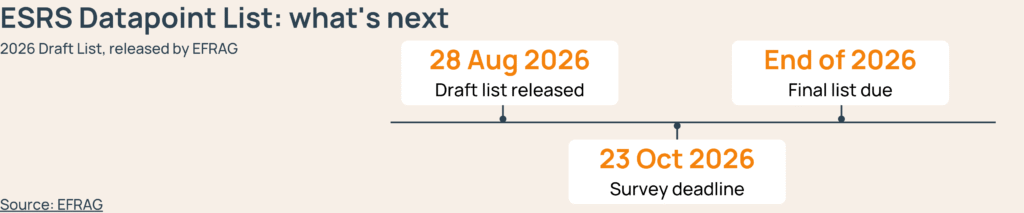
EFRAG has released its 2026 Draft List of ESRS Datapoints. It pulls every data point definition into one Excel workbook, and reflects the simplified ESRS that the European Commission adopted in July 2026.
Three things make it easier to use than the 2024 version: data points are sorted by data type, links take you straight to the interactive ESRS in EFRAG’s Knowledge Hub, and a separate version maps each item back to the original 2023 standards, so you can see exactly what changed. EFRAG SR TEG Chair Chiara Del Prete said the team had received hundreds of requests for an updated list.
What to do: this is the practical bridge between the simplified standards and your reporting systems. Use it to map your existing data against the revised requirements now, and flag any errors through EFRAG’s survey before the deadline shown above. The final list follows on the date shown too.
Source: EFRAG
Regulation & policy spotlight
New Zealand bans climate damage lawsuits against companies
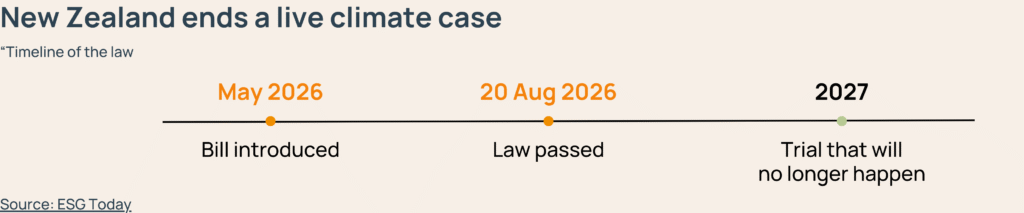
New Zealand’s Parliament has passed a law stopping courts from finding companies liable for climate damage caused by greenhouse gas emissions. Justice Minister Paul Goldsmith said courts “are not the right place to resolve claims of harm from climate change.”
The law’s timeline is shown above. It moved while six of the country’s biggest emitters, including Fonterra, faced claims from Māori climate activist Mike Smith. The Supreme Court had already allowed those claims to proceed, ahead of a trial that will now no longer happen. Smith called the move “an affront to democracy.” Greenpeace called it “corporate capture.”
This is the first time a government has legislated to end a pending corporate climate case. Companies operating in New Zealand gain certainty, but the wider signal is that litigation risk is now itself a political target.
Source: ESG Today
Australia plans a new crime: failing to prevent modern slavery
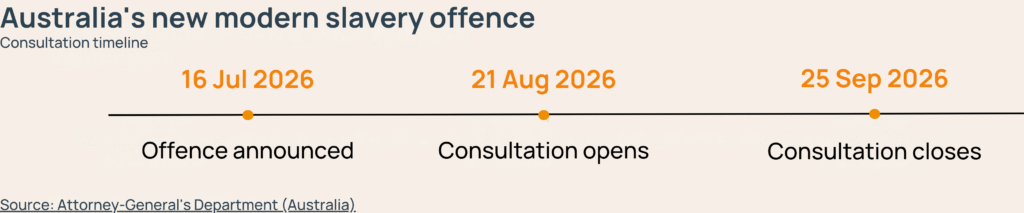
Australia’s Attorney-General’s Department has opened a consultation, on the timeline shown above, on strengthening its response to modern slavery in supply chains. It follows the government’s earlier announcement of a new criminal offence for failing to prevent modern slavery.
The model follows the UK’s failure-to-prevent offences: a company is liable unless it can show it took reasonable steps. What counts as “reasonable steps” is exactly what is being decided now, and it will become the benchmark for supply chain due diligence in Australia. Reporting entities should respond rather than wait for the bill.
Source: Attorney-General’s Department (Australia)
Deloitte pays $21.5 million to settle US discrimination claims over DEI targets
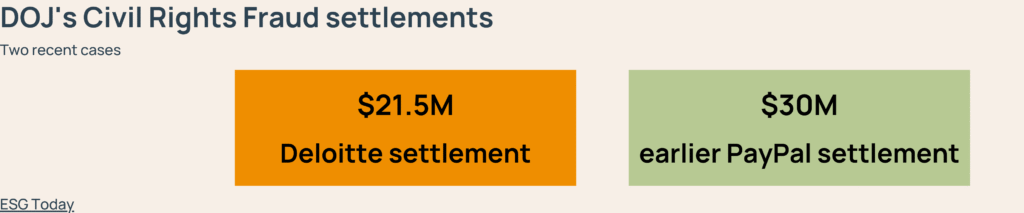
The US Department of Justice announced the settlement shown above, in which Deloitte agreed to pay over claims it considered race and sex in hiring, promotion and staffing to meet internal workforce targets. The DOJ said business units received monthly reports rating progress against those targets in green, amber or red, and that partners were assessed partly on their contribution to them.
The case is part of the DOJ’s Civil Rights Fraud Initiative, which uses the False Claims Act against federal contractors because they certify compliance with civil rights law. It follows an even larger earlier settlement with PayPal (shown above for comparison), an investigation into Nike, and a lawsuit against the New York Times.
What to do: if you hold US federal contracts, diversity targets tied to individual performance reviews are now a legal risk, not just a reputational judgement.
Source: ESG Today
EU steps back from its shared green taxonomy with China
The European Commission confirmed it will not join the next phase of the Common Ground Taxonomy, the project mapping the EU taxonomy against China’s and other countries’ green classifications. It cited weak demand from the EU market, the resources involved, and a need to keep the EU taxonomy’s own legal and technical identity clear.
For issuers hoping the CGT would simplify green bond labelling between Europe and Asia, that route is now closed.
Source: Green Central Banking
Standards, reporting & frameworks
ESMA opens its register of ESG ratings providers
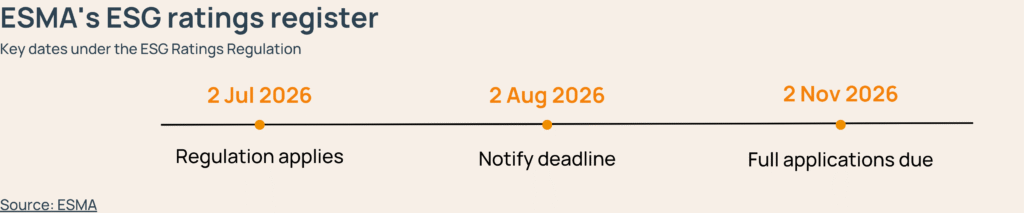
ESMA has published its first register of ESG rating providers under the ESG Ratings Regulation (EU) 2024/3005. Providers had a first deadline to tell ESMA they intend to keep operating in the EU, and now have until the full application deadline shown above. Once a provider has notified, it is listed temporarily and can keep working until its application is decided.
This brings ratings providers under direct ESMA supervision for the first time, with rules on methodology transparency, separating ratings from other services, and managing conflicts of interest.
What to do: check whether your ratings providers appear on the register, and watch for methodology changes as the new rules bite.
Source: ESMA
ISSB nature reporting draft due in October as TNFD steps back
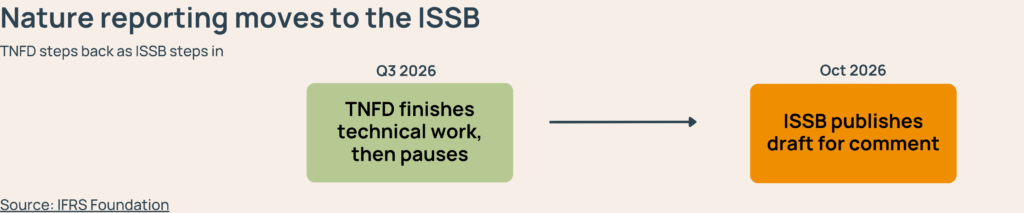
The ISSB plans to publish a draft on nature-related disclosures for public comment, including asking whether an IFRS Practice Statement is the right format. The TNFD will finish its current technical work on the timeline shown above, and then pause further guidance.
Nature reporting is being folded into the ISSB, repeating what happened with the TCFD. Work built on TNFD recommendations is not wasted, but expect the requirements to be restated in ISSB form.
Source: IFRS Foundation
Australia: Treasury looks at easing climate reporting checks
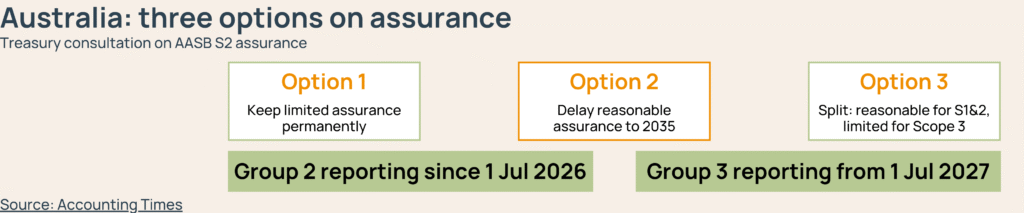
Treasury has opened a consultation on cutting the cost of sustainability reporting under the AASB S2 regime, after pushback from business groups. It offers the three options shown above for how far to ease the move to reasonable assurance.
Treasury is clear that it is not reconsidering Scope 3 reporting itself, or which companies must report, the reporting start dates for each company group are shown above.
Business groups want more. The Australian Chamber of Commerce and Industry welcomed the review and says it will push to drop mandatory Scope 3. The Australian Sustainable Finance Institute wants proportionate assurance without weakening data quality. The practical point stands: easing the assurance rules does not remove the underlying data work.
Source: Accounting Times
Legal watch
Cisco Systems v. Doe I: US Supreme Court closes the door on human rights claims against companies

A group of unnamed Falun Gong practitioners, Chinese and US citizens, sued Cisco Systems under the Alien Tort Statute and the Torture Victim Protection Act. They said Cisco knowingly helped design and build the “Golden Shield” surveillance system for the Chinese government, and that data collected through it was used to identify, detain and torture them, making the company an accomplice to torture, forced labour and arbitrary detention.
The plaintiffs argued that helping someone commit a crime is a recognised principle of international law, and that both statutes allow such claims. Cisco argued neither statute creates a claim against an accomplice, and that courts should not invent one.
The Supreme Court has now ruled for Cisco, on the date shown above. It held that federal courts cannot create new private claims under the Alien Tort Statute, and that the Torture Victim Protection Act does not cover accomplices. Its reasoning was about the separation of powers: creating new legal claims is Congress’s job, and the narrow room left to courts by Sosa v. Alvarez-Machain does not extend this far.
The dissent said the Court had shut the courthouse doors to almost every future claimant, overruling Sosa without admitting it. In practice, US courts are now largely closed to claims that a company enabled human rights abuses abroad. That pushes corporate human rights litigation towards Europe, and raises the stakes of the CSDDD fight in this edition’s top story.
Source: Supreme Court of the United States (opinion, No. 24-856)
Trends, research & insights
Sustainalytics closes its stewardship business
Morningstar Sustainalytics is shutting its stewardship engagement service, calling the decision strategic. It is the second business it has closed this year, after exiting second-party opinions, as Morningstar focuses on core ESG and climate data. The retreat comes even though investors say engagement remains a priority.
Clients are left with engagements mid-conversation, screening cycles running and a voting season approaching. Minerva Analytics and Stewardpoint are positioning to pick up the work.
The pattern is worth noting: as reporting obligations loosen, so does the commercial case for parts of the ESG services market.
Source: Environmental Finance
Carbon platforms Climate Impact X and Carbonplace to merge
Singapore-based exchange Climate Impact X and London-based Carbonplace will merge, combining a trading venue with a bank-backed settlement network.
Consolidation here suggests the voluntary carbon market still lacks the liquidity to support several competing platforms, worth watching if carbon credits feature in your transition plan.
Source: ESG Today
Stay a step ahead with TomorrowWorks
From a US submission that could reopen the CSDDD to a new ESRS data point list you can build your reporting around, sustainability regulation is moving fast, and in several directions at once. TomorrowWorks helps organisations cut through the complexity: we track what matters, turn it into clear obligations and timelines, and help you build a reporting and strategy response that stands up to scrutiny. Find out more here.