

Starting this week, we include a new section on legal watch to highlight relevant ESG court cases
Top story
EU packaging regulation takes effect: PFAS limits and traceability requirements now apply
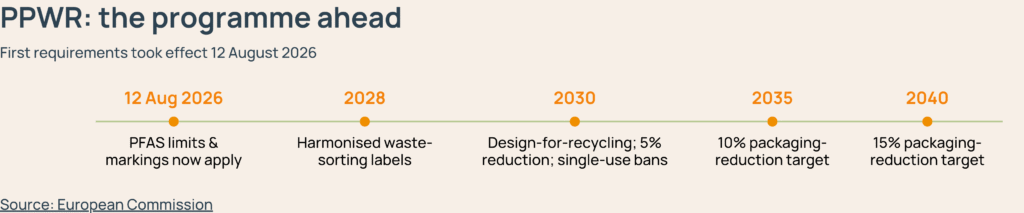
On 12 August, the first PPWR requirements took effect: food-contact packaging above set PFAS thresholds can no longer be sold in the EU, and packaging must now carry manufacturer or importer markings.
This is the start of a longer programme: harmonised waste-sorting labels arrive in 2028, all packaging must be designed for recycling by 2030, certain single-use plastics are banned by 2030, and packaging-reduction targets follow at 5% by 2030, 10% by 2035, and 15% by 2040.
Producers, importers and brand owners selling into the EU should screen food-contact lines against the PFAS thresholds now, and build the 2030 design-for-recycling requirement into current packaging development cycles.
Source: European Commission
Regulation and policy spotlight
Commission publishes ten guidance documents for CBAM’s definitive period
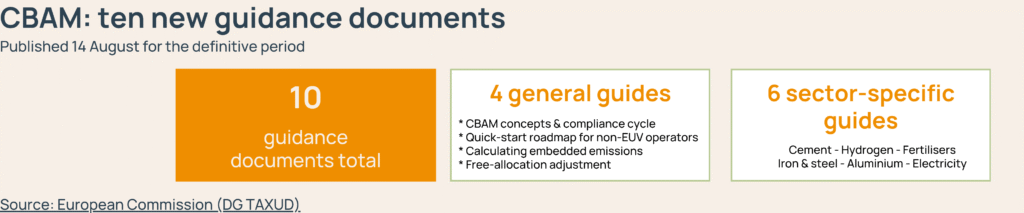
On 14 August, the Commission published ten guidance documents to support CBAM’s definitive period, when full monitoring, reporting and financial obligations apply to importers of carbon-intensive goods.
The set includes four general guides (CBAM concepts and the compliance cycle, a quick-start roadmap for non-EU operators, calculating embedded emissions, and the free-allocation adjustment) plus six sector-specific guides with worked examples for cement, hydrogen, fertilisers, iron and steel, aluminium, and electricity.
Importers and their non-EU suppliers should use the guidance now to set up monitoring plans and verification-ready processes, so 2026 imports can be reported using actual rather than default emission values.
Source: European Commission (DG TAXUD)
Country and market spotlight
India: renewables hit a record 20% of the power mix as coal’s share falls
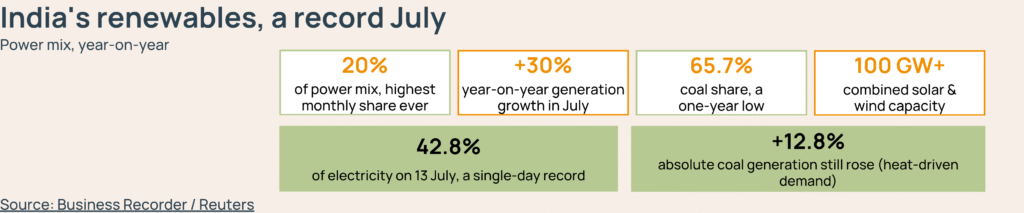
India’s renewable generation rose 30% year-on-year in July to a record 36.25 billion kWh, lifting renewables to 20% of the power mix, their highest monthly share ever, while coal’s share fell to a one-year low of 65.7%. Solar and wind capacity crossed 100 GW and supplied a record 42.8% of electricity on 13 July.
The caveat: absolute coal generation still rose 12.8% on heat-driven demand and weak hydropower, a reminder that share gains and absolute emissions can move in opposite directions.
Source: Business Recorder / Reuters
Brazil: Amazon deforestation heads for its lowest level on record

Deforestation alerts in the Brazilian Amazon fell 37% year-on-year in the twelve months to July, the lowest level in the Deter alert series, putting Brazil on track for its lowest official annual deforestation figure since satellite measurement began in 1988.
For companies with EUDR exposure, the trendline matters, but the compliance obligations from December do not change.
Source: Mongabay
Standards, reporting and frameworks
Singapore proposes ISSB-aligned sustainability reporting standards
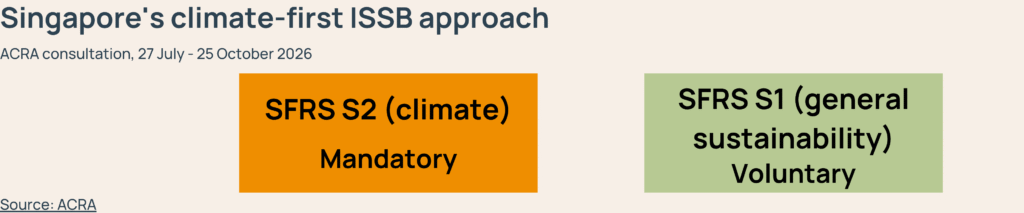
Singapore’s ACRA opened a public consultation, running from 27 July to 25 October, on draft Singapore Sustainability Disclosure Standards based on the ISSB’s IFRS S1 and S2: climate reporting under SFRS S2 would be mandatory, while broader sustainability disclosure under SFRS S1 stays voluntary.
The move continues Asia’s disclosure build-out after Korea’s and Bangladesh’s ISSB-based mandates covered in earlier editions, adding another jurisdiction to the ISSB-aligned bloc even as the EU and US simplify or retreat.
Source: ACRA
UK SRS: FCA moves towards mandatory climate reporting from 2027
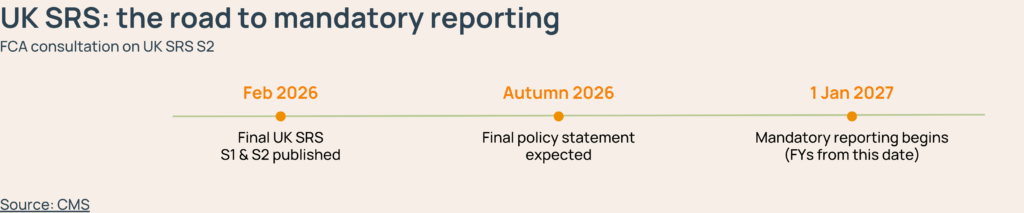
Following the government’s publication of the final UK Sustainability Reporting Standards (UK SRS S1 and S2) in February, the FCA is consulting on requiring listed companies to report against UK SRS S2 for financial years beginning on or after 1 January 2027, with a final policy statement expected in autumn 2026. A separate consultation on extending mandatory reporting to economically significant private companies is due later this year.
UK-listed issuers should treat the voluntary standards as the de facto baseline now, and pressure-test their climate disclosures against them this reporting cycle.
Source: CMS
Legal watch
Milieudefensie v Shell: the corporate climate duty of care reaches the Dutch Supreme Court
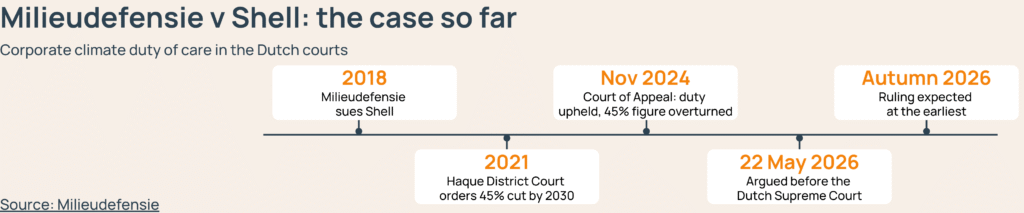
Milieudefensie (Friends of the Earth Netherlands), joined by six co-plaintiff organisations, sued Shell in 2018, arguing that the unwritten duty of care in the Dutch Civil Code, read alongside human rights obligations and the Paris Agreement, requires Shell to cut its CO2 emissions by 45% by 2030 against 2019 levels.
In 2021, The Hague District Court agreed and imposed that 45% reduction order, the first time a court had ordered a specific emissions target on a private company. In November 2024, The Hague Court of Appeal overturned the specific percentage: it confirmed Shell owes a duty of care to reduce emissions, protect human rights, and contribute fairly to the Paris goals, but held there isn’t enough scientific consensus to set a precise reduction percentage for one company, and that ordering one might not even work.
On 22 May 2026, the case was argued before the Dutch Supreme Court, the first time any national supreme court has considered a company’s civil-law obligation to cut CO2, with Milieudefensie arguing the appeal court applied a narrower standard to the remedy than to the duty itself.
A ruling is expected at the earliest in autumn 2026, after a final written round and the Attorney General’s advisory opinion. Whichever way it falls, it will set the benchmark for corporate climate duty-of-care claims across Europe.
Source: Milieudefensie
To know more
- EU AI Act transparency obligations take effect: On 2 August, the AI Act’s transparency rules took effect: users must be clearly told when they’re interacting with an AI system rather than a person, and certain AI-generated content, deepfakes, emotion-recognition and biometric-categorisation outputs, and unreviewed AI-written text on matters of public interest, must carry visible labels and machine-readable marks using the EU’s new labelling icons. Source: European Commission
- SBTi opens second consultation on its Power Sector Net-Zero Standard: SBTi opened a second public consultation on its updated Power Sector Net-Zero Standard, running from 15 July to 31 August 2026, setting sector-specific requirements including a proposed asset-level decarbonisation plan approach and clarifying how the standard interlocks with the Corporate Net-Zero Standard V2.0. Source: Science Based Targets initiative
- Lloyds targets over £100 billion in sustainable and transition finance: Lloyds Banking Group set a new target on 13 August to facilitate more than £100 billion in sustainable and transition finance between 2027 and 2030, up from the £70.9 billion delivered since 2022, explicitly folding in transition finance for hard-to-abate sectors like Deutsche Bank and NatWest before it. Source: ESG Today