

This fortnight, the rulebook for corporate sustainability reporting was redrawn on three fronts: EFRAG opened consultation on the last missing piece of the CSRD, California limits its Scope 3 requirements after cost concerns, and ISO and GHG Protocol agreed to merge the world’s two dominant carbon accounting standards into one. Meanwhile, record-scale capital kept flowing into clean-firm power, driven in no small part by the energy appetite of the AI buildout.
Top story
EFRAG opens consultation on ESRS-40a – CSRD reporting rules for non-EU groups
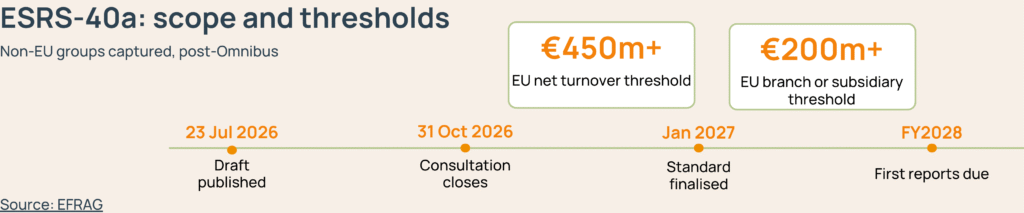
EFRAG published the Exposure Draft of ESRS-40a, the sustainability reporting standard for large non-EU companies with significant EU activity, the final piece of the CSRD architecture.
Following the Omnibus scope reduction, roughly 1,200 third-country groups (down from ~10,000) with EU net turnover above €450 million and an EU branch or subsidiary above €200 million are captured, with first reports due on financial year 2028.
Unlike the full ESRS, the draft focuses exclusively on impact materiality, dropping risks, opportunities, resilience and dependencies, and introduces a contested “mixed approach” letting companies report non-climate impacts either globally or only where EU-related, an option EFRAG’s own experts flagged for greenwashing risk and which was included at the European Commission’s explicit request.
Non-EU parented groups (US, UK, Swiss and Japanese head offices in particular) should map their EU turnover against the thresholds and consider responding to the consultation.
Source: EFRAG
Regulation and policy spotlight
California limits initial Scope 3 reporting to five categories
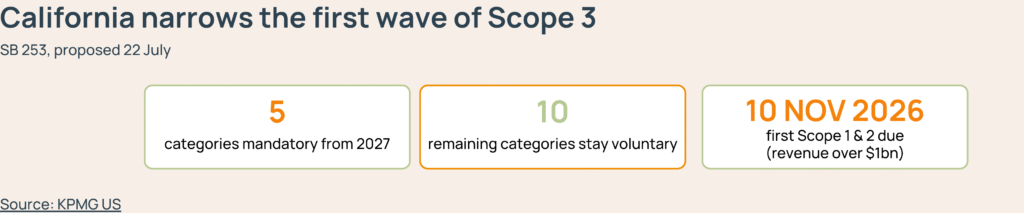
At a 22 July workshop on the SB 253 climate disclosure regulation, CARB proposed limiting the first wave of Scope 3 reporting (from 2027) to five value-chain categories, purchased goods and services, fuel- and energy-related activities, waste, business travel and employee commuting, after companies flagged cost and data-availability concerns; the remaining ten GHG Protocol categories would stay voluntary for now.
CARB also proposed limited assurance on Scope 1 and 2 from 2027 and confirmed insurers will be pulled into reporting from 2027. First Scope 1 and 2 disclosures from companies with revenues above $1 billion doing business in California remain due by 10 November 2026.
Source: KPMG US
ECB to apply its climate factor to corporate loans pledged as collateral
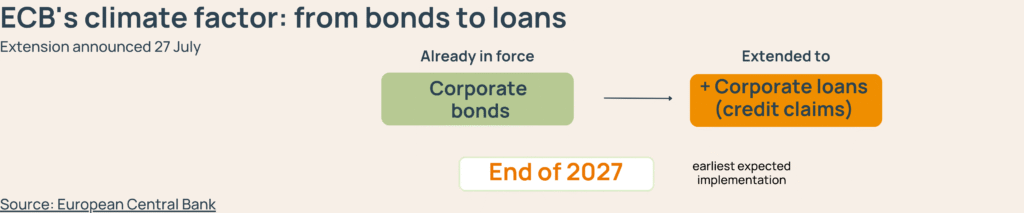
Two weeks after its climate factor for corporate bonds entered into force, the ECB announced on 27 July that it will extend the mechanism to credit claims on non-financial corporations. Implementation is expected by end-2027 at the earliest, but the direction is clear: transition risk is being priced into the plumbing of euro-area central banking, and loans to transition-exposed borrowers will fund less.
Source: European Central Bank
Standards, reporting and frameworks
ISO and GHG Protocol to merge into a single global carbon accounting standard
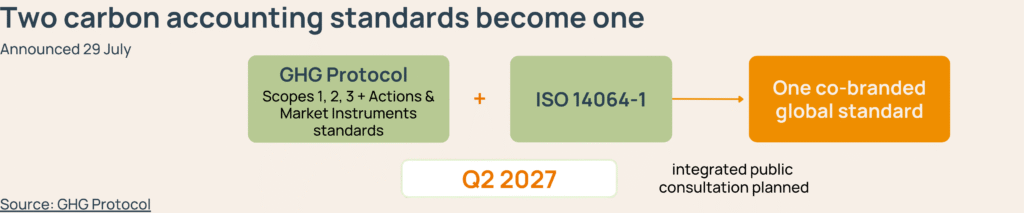
ISO and GHG Protocol announced on 29 July they will combine their corporate carbon accounting standards, GHG Protocol’s Scope 1, 2, 3 and Actions & Market Instruments standards with ISO 14064-1, into one co-branded global standard, with an integrated public consultation planned for Q2 2027. For reporting teams, this is significant simplification in the making: one harmonised language for emissions accounting across markets and jurisdictions, and one consultation process to engage with instead of two.
Source: GHG Protocol
Companies push back hard on stricter Scope 2 rules
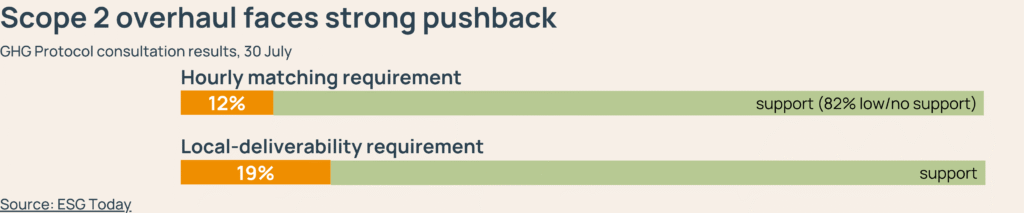
GHG Protocol’s consultation results, released 30 July, show only 12% of companies support the proposed hourly matching requirement for renewable electricity claims (82% low or no support), and just 19% back the local-deliverability requirement. Cost, data burden and fears of chilling voluntary clean-power procurement were the main objections. GHG Protocol will now revise the draft and explore offering multiple reporting approaches, meaning the feared overhaul of market-based Scope 2 claims is likely to arrive later, and softer, than first proposed.
Source: ESG Today
Country and market spotlight
Singapore consults on ISSB-based climate disclosure standards

Singapore’s ACRA launched a public consultation on the draft Singapore Sustainability Disclosure Standards. Built on the ISSB’s IFRS S1 and S2, the drafts take a “climate-first” approach: only climate disclosures would be mandatory, with broader sustainability reporting remaining voluntary, alongside tailored transition reliefs.
Source: ACRA
Trends, research and insights
Deutsche Bank posts strongest sustainable finance quarter in over four years
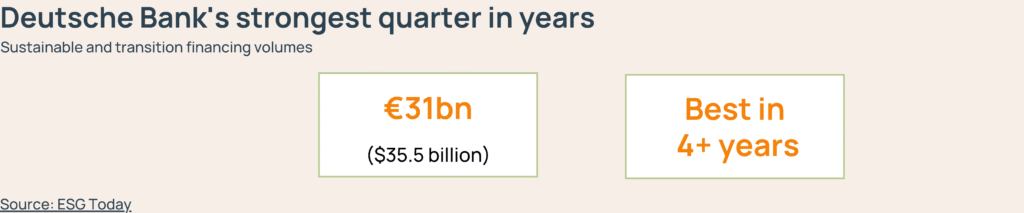
Deutsche Bank reported €31 billion ($35.5 billion) in sustainable and transition financing volumes for the quarter, its best result in more than four years, a data point suggesting that, whatever the political mood, transition finance demand from corporates and investors is holding up.
Source: ESG Today

Stay a step ahead with TomorrowWorks
From ESRS-40a’s reach into non-EU boardrooms to California’s shifting Scope 3 rules, sustainability regulation is moving fast, and in several directions at once. TomorrowWorks helps organisations cut through the complexity: we track what matters, translate it into practical obligations and timelines, and help you build a reporting and strategy response that stands up to scrutiny. Find out more here.
Enjoyed this edition? Subscribe to receive Sustainability Clarified in your inbox every two weeks.