

EU regulators set out what they will check in sustainability reports and how they judge green claims. The ISSB proposed new nature-related disclosures and nature reporting tools were updated during the UN biodiversity summit. A London court let a Niger Delta oil pollution claim against Shell move towards trial.
Top story
EU enforcers say what they will check in your 2026 sustainability report
The European Securities and Markets Authority (ESMA) has published its 2026 European Common Enforcement Priorities. Sustainability reporting is again on the list. National enforcers will focus on how companies assess materiality: the impacts, risks and opportunities they report, and how they reached them.
ESMA says some companies give more detail on positive impacts than on negative ones. It wants both with the same level of detail, covering the company’s own operations and its value chain. Enforcers will look closely at the climate standard (ESRS E1) and the own-workforce standard (ESRS S1).
On targets, ESMA wants measurable, time-bound goals, and a clear statement of whether each target was met, missed or dropped. Terms such as “science-based” or “1.5 degrees” should be explained, and absolute emissions should be shown, not only intensity.
What to do: Review your double materiality assessment and your target disclosures against these points before you finalise your next report. Make sure negative impacts are covered as fully as positive ones.
Source: ESMA: 2026 European Common Enforcement Priorities
Regulation & Policy Spotlight
ESMA sets out how funds should word impact and climate transition claims
On 14 October ESMA published a note on sustainability claims for funds and bonds, focused on “impact” and “climate transition” claims. It is guidance and creates no new legal duties. It builds on ESMA’s earlier notes on ESG labels and ESG integration.
Claims should be accurate, accessible, substantiated and up to date. A product should not be called an “impact” product only because of its asset class or sector. Transition claims need a clear ambition, targets, metrics and progress. ESMA also warns against presenting a lower-carbon portfolio as if it were a cut in real-world emissions.
What to do: If you market funds, bonds or other financial products with impact or transition claims, check each claim against these four tests. Regulators will use them to judge greenwashing.
Source: ESMA: clarity in claims on impact and transition
EU agrees to raise the carbon market reserve threshold to 700 million allowances
On 20 October the Council and the European Parliament reached a provisional deal on the EU Emissions Trading System (ETS) market stability reserve. The level above which allowances are cancelled rises from 400 million to 700 million, to improve liquidity and predictability in the carbon market.
The Commission had proposed to stop cancellations altogether. The deal keeps the mechanism. More than 3 billion allowances have been cancelled since 2023. A gradual decrease of the threshold may be considered in the wider ETS review.
Both institutions must now formally adopt the text.
Source: Council of the EU: ETS market stability reserve
Council backs relief for small packaging producers
On 21 October the Council set its position on a proposal to suspend one rule in the EU Packaging Regulation (PPWR). Today, a producer selling packaging into several member states must appoint an authorised representative in each one.
Under the Council text, EU-based producers placing less than 1 tonne a year of packaging on a country’s market would not need to appoint one there. A safeguard applies if a producer breaks the producer responsibility rules. The Commission must review the suspension by 31 December 2030.
This is a negotiating position, not law. Talks with the Parliament start next, and a full producer responsibility solution is expected in the Circular Economy Act.
What to do: If you sell small volumes of packaged goods across several EU countries, check your volumes per country. Keep your registration plans until the final text is agreed.
Source: Council of the EU: packaging simplification
EU sets its line for the COP31 climate and COP17 biodiversity summits
On 12 October the Council approved the EU’s positions for the next two UN summits. Ministers say the 1.5°C limit is likely to be exceeded. They back a path that overshoots 1.5°C and then brings warming back below it by the end of the century. The EU will call for a transition away from fossil fuels and for countries to submit missing national climate plans.
For nature, the EU will push for faster action on protecting 30% of land and sea by 2030 and will look at high-integrity nature credits. The biodiversity summit (COP17) runs 19–30 October in Yerevan. The climate summit (COP31) runs 9–20 November in Antalya.
Source: Council of the EU: positions for COP31 and COP17
Country & Market Spotlight
South Korea launches a 1,000 trillion won decarbonisation plan

On 8 October the Korean government announced its Korean Green Transformation (K-GX) strategy. It aims to mobilise 1,000 trillion won (about USD 747 billion) over ten years. The money comes from three sources: state budgets, state-backed climate finance such as low-interest loans and green bonds, and private projects (the split is shown above).
Priority sectors are steel, petrochemicals and refining, cement, and semiconductors and displays. The plan targets 100 GW of domestic renewables and zero-emission vehicles above 70% of new car sales by 2035.
Source: ESG Today: South Korea launches K-GX strategy
Canada leaves oil and gas “abatement” out of its green taxonomy for now
On 21 October the Canadian Taxonomy and Transition Planning Council published the final methodology report for Canada’s sustainable finance taxonomy. It has “green” and “transition” categories. The Council found too little evidence to decide whether oil and gas abatement belongs, so it will research the question from 2027. A July draft had proposed it, and most stakeholders opposed it.
Do-no-significant-harm and minimum social safeguards work on a “disclose or explain” basis. Technical criteria come first for electricity, buildings and transport, and for other sectors by the end of 2027.
What to do: If you raise or lend green finance in Canada, plan around the green and transition categories. Do not count on abatement projects being classed as eligible.
Source: ESG Today: Canada’s sustainable finance taxonomy
Standards, Reporting & Frameworks
ISSB proposes nature-related disclosures for companies using its standards
On 22 October the International Sustainability Standards Board (ISSB) opened a consultation on nature-related disclosures. It proposes an IFRS Practice Statement, which helps companies give investors material information on nature-related risks and opportunities, including how their dependencies and impacts on nature create them.
A Practice Statement has the same level of detail as a Standard. The difference is that a company does not have to follow it in order to state compliance with ISSB Standards. IFRS S1 already requires material nature-related risks and opportunities to be disclosed, and the proposal adds detail on how. The ISSB drew heavily on the TNFD and says companies using GRI or ESRS alongside it should be able to do so efficiently.
The ISSB also asks whether the content should be finalised as a Practice Statement or issued in another form, such as a Standard. Comments are open for 120 days, until 19 February 2027. No effective date has been set.
What to do: If you report under ISSB-based rules, compare your nature disclosures with the draft and respond by 19 February 2027. Companies already using TNFD will find much of it familiar.
Source: IFRS Foundation: ISSB consults on nature-related disclosures
TNFD and SBTN update their nature tools ahead of the biodiversity summit
On 13 October the Taskforce on Nature-related Financial Disclosures (TNFD) released LEAP 2.0, the first update of its Locate, Evaluate, Assess, Prepare approach. It adds guidance on measuring the state of nature, financial institution portfolios, environmental crime, transition planning and invasive alien species. TNFD says this completes its guidance and that its technical work ends in late 2026, with future focus on supporting standard-setting at ISSB, GRI and ISO.
The same day the Science Based Targets Network (SBTN) released version 2.0 of its corporate nature target methods. It offers more flexible pathways, including focused scopes, supplier engagement targets and stepwise validation, and covers pesticide-related freshwater impacts.
TNFD also reports 836 organisations committed to TNFD-aligned reporting.
What to do: If you report on nature, update your assessment process to LEAP 2.0. The new ISSB draft builds on TNFD work.
Source: TNFD: LEAP approach guidance · ESG Today: SBTN framework · ESG Today: TNFD adopters
EFRAG sustainability reporting board chair steps down after five months
Kerstin Lopatta has left her role as chair of the EFRAG Sustainability Reporting Board, five months into a three-year term. Media reports cite governance disagreements, and EFRAG has not commented on the circumstances. Kristian Koktvedgaard is acting chair.
This comes while EFRAG is finishing the revised ESRS datapoints and taxonomy. A new chair will be nominated by the Commission after consulting the Parliament and the Council. Watch whether the leadership change affects EFRAG’s timetable.
Source: ESG Today: EFRAG chair steps down
Legal watch
Alame and others v Shell: London court lets Niger Delta pollution claim move towards trial
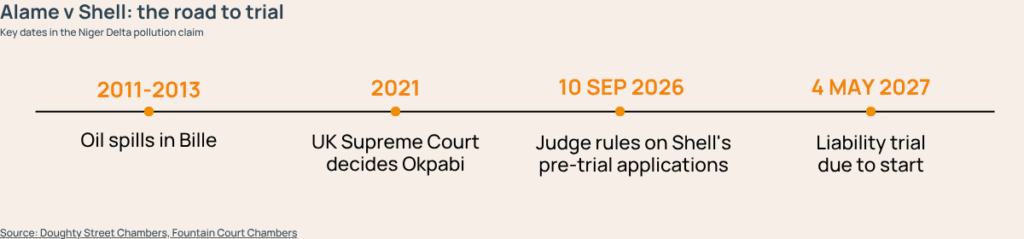
Alame and others, who represent the Bille (and Ogale) communities of the Niger Delta, are suing Shell Plc and its Nigerian subsidiary, Shell Petroleum Development Company of Nigeria. They claim damages for oil pollution from pipeline and infrastructure spills in Bille during the period shown above. The claim also targets the parent company’s own responsibility. The case is in the High Court of England and Wales, King’s Bench Division. The UK Supreme Court already held in Okpabi that the parent can be sued in England.
Mrs Justice Lambert has now ruled on two Shell applications before trial, and Shell lost both. Shell asked to stop the claimants arguing that it is responsible for all oil pollution in the Bille region, not only the 106 identified spills. The judge held the claims are “not all or nothing” and are not “global claims”, the claim was pleaded with enough clarity, and claimants may rely on inferences that unidentified spills caused pollution if the rest of their case is proved.
Shell also asked that claimants’ allegation that Shell witnesses gave false or misleading evidence and destroyed evidence in the earlier jurisdiction proceedings be left until after the main trial. The judge refused. She said the allegations bear on credibility and that delay would be a cost. The claimants may now seek aggravated damages.
This is not a finding on liability. The liability trial is due to start on the date shown above. If the claimants succeed, a UK-based parent company could face region-wide pollution liability without the claimants proving each spill. Note that the sources are summaries by counsel for the parties, not the judgment itself.
What to do: If your group has operations in high-risk regions, check what you know and what you have said about local pollution incidents. Courts may test your past statements.
Source: Doughty Street Chambers: case summary · Fountain Court Chambers: case summary
Trends, Research & Insights
Investors now rate their own research above ESG ratings
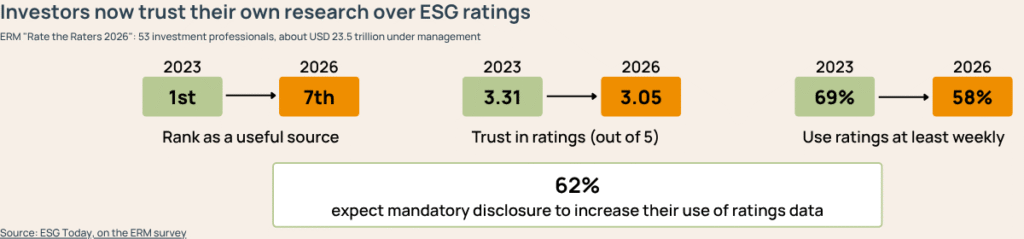
A survey for ERM, “Rate the Raters 2026”, asked investment professionals how they use ESG data. Corporate ESG ratings have dropped as a useful source for investment decisions. In-house research is now first and direct engagement second.
Trust in ratings has fallen, and fewer investors use them weekly. Even so, most expect mandatory disclosure to increase their use of ratings data. The sample is small, so treat the figures as a signal. All figures are shown above.
What to do: Expect investors to question you directly. Make sure your own reports answer their questions without relying on a rating.
Source: ESG Today, on the ERM survey
JPMorgan keeps its financed-emissions targets but changes how it frames them
On 14 October JPMorgan said it will keep and extend its financed-emissions targets for oil and gas, electric power and auto manufacturing, now to 2035. The oil and gas target is a 47% cut in intensity. It also called financed emissions “an imperfect metric”.
Progress on its USD 2.5 trillion sustainable finance goal reached USD 1.2 trillion by the end of 2025. 2025 volume of USD 217 billion was lower than the USD 250 billion in 2024, and the bank widened what counts as green, adding nuclear and grid projects. A new Center for Energy and the Environment replaces its earlier carbon transition centre.
Source: ESG Today: JPMorgan updates its sustainable finance strategy
Stay a Step Ahead with TomorrowWorks
Sustainability regulation keeps changing, and the cost of guessing wrong keeps rising. TomorrowWorks helps organisations cut through the complexity of sustainability regulation: which rules apply to them, what they have to do, and by when.
Know someone who should be reading this? Forward it on, and subscribe here.