

Top story
UK drops mandatory climate reporting for listed companies
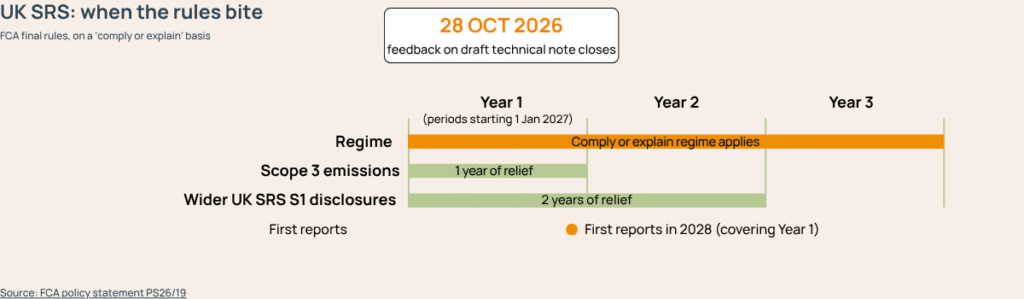
The UK Financial Conduct Authority has published its final rules on sustainability reporting by listed companies (policy statement PS26/19). It has dropped its earlier plan to make climate reporting mandatory. Instead, all reporting under the new UK Sustainability Reporting Standards (UK SRS) works on a “comply or explain” basis.
The rules apply to accounting periods starting on the date shown above, with first reports in the year shown. There is a shorter period of relief for Scope 3 emissions and a longer one for wider UK SRS S1 disclosures (both shown above). The regime replaces the current TCFD-based rules in the Listing Rules.
“Explain” is not an off-switch. Material sustainability risks that are principal risks must still be disclosed. Transition plans are not mandatory, but companies must say whether and where they have published one, or explain why not. The FCA is taking feedback on a draft technical note until the date shown above.
What to do: If you are UK listed, plan your first UK SRS report for your first period under the regime and decide now where you will comply and where you will need to explain. Your explanations will be read by investors.
Source: [FCA policy statement PS26/19]
Regulation & Policy Spotlight
EU auditors set out the rules for sustainability assurance
On 25 September the EU committee of audit regulators (CEAOB) gave the European Commission its technical advice on the EU limited assurance standard. The standard will build on the international standard ISSA 5000, with some EU-specific additions.
The advice covers limited assurance only, and covers all the sustainability information a company must report. It proposes that the assurance provider must not redo work already covered by a legally required third-party report, and must talk to the financial statement auditors before both reports are signed. It proposes that the standard applies to reporting periods starting on or after 15 December 2027.
The Commission will use the advice for a delegated act. Accountancy Europe expects a public consultation shortly.
What to do: Ask your assurance provider how they plan to work to the EU standard, and check that your reporting controls and audit trail are ready for it.
Source: [CEAOB technical advice]
Council agrees its position on faster environmental assessments
On 30 September the Council of the EU set its negotiating position on a proposal to speed up environmental assessments. It is part of the “Omnibus VIII” simplification package. The proposal would create simplified procedures, single points of contact and digital tools for project developers.
The Council limits the fast track to projects on a fixed list, extends the Commission’s proposed deadlines, and changes the rules on public participation to comply with the Aarhus Convention. It also wants a targeted solution explored for small packaging producers facing disproportionate extended producer responsibility (EPR) costs.
The Council will open talks with the Parliament once the Parliament has set its own position. The Irish presidency aims for agreement by the end of the year.
Source: [Council of the EU]
Three EU dates to put in the diary
Following the State of the Union address on 16 September, the Commission is expected to publish its 2027 Work Programme on 20 October, a Climate Resilience Framework on 28 October, and a Circular Economy Act on 11 November.
The President also said the EU’s existing climate targets stay in place, and put more emphasis on adaptation, including a Climate Insurance Alliance.
Source: [Linklaters, State of the Union 2026 takeaways]
Country & Market Spotlight
21 US states sue to overturn the repeal of power plant emission limits
On 5 October a group of 21 state attorneys general, led by New York, filed a petition asking a federal court to strike down the EPA’s repeal of greenhouse gas limits on fossil fuel power plants. Cities and the Governor of Pennsylvania joined them.
They argue the repeal is “arbitrary and capricious”. In their view, the EPA did not properly consider alternatives or count the health and climate costs of higher emissions. The states also filed a separate notice that they intend to sue over the EPA’s failure to regulate existing gas-fired plants.
The practical point for companies: federal rules on power plant emissions are now in court, and state rules and customer expectations are not going away.
Source: [ESG Today]
Hong Kong issues a record digital green bond
On 28 September the Hong Kong government priced two digital green bonds worth about HK$14.3 billion. One is a 7.5 billion yuan, five-year bond with a 1.65% coupon. The other is a HK$5.5 billion, two-year bond with a 3.8% coupon.
Both are issued electronically on HSBC’s Orion platform and will be listed in Hong Kong. Proceeds go to eligible projects under the government’s Green Bond Framework.
Source: [The Standard (Hong Kong)]
Standards, Reporting & Frameworks
Three EFRAG consultations are open now
EFRAG is asking for feedback on three drafts linked to the revised ESRS. Comments on its methodology for the 2026 list of datapoints are due by 23 October. The survey on the draft ESRS for non-EU companies (the standard for non-EU groups with significant EU activity) closes on 31 October. Feedback on the draft digital (XBRL) taxonomy for the revised ESRS is due by 11 November.
EFRAG plans to send the final datapoint list and taxonomy to the Commission and ESMA by the end of 2026. Digital tagging is not yet mandatory.
What to do: If you report under the CSRD, or are a non-EU group that may be in scope, check the drafts and respond by the deadlines.
Source: [EFRAG: draft ESRS XBRL taxonomy]
ISSB nature disclosure draft is due around COP17
The International Sustainability Standards Board plans to publish an exposure draft on nature-related disclosures around the October 2026 meeting of the UN biodiversity convention (COP17). It would be a practice statement that supplements IFRS S1 and S2 without changing them, and it draws on the TNFD framework, including the LEAP approach.
The comment period is set at 120 days. We could not confirm on 8 October that the draft has been published, and the October date is a target, not a commitment.
Source: [OneStopESG summary of the ISSB plan]
Legal watch
Suncor Energy v Boulder County: US Supreme Court hears climate lawsuit against oil companies
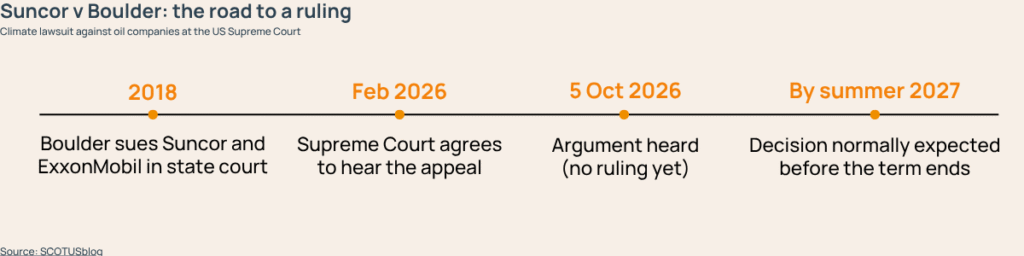
The US Supreme Court has heard argument in Suncor Energy Inc. v. County Commissioners of Boulder County (No. 25-170). The City and County of Boulder, Colorado, sued Suncor and ExxonMobil in state court. It seeks money for the costs of protecting property and residents from climate change. It says the companies deceived the public about climate change and contributed to it through producing, refining and marketing fossil fuels.
The companies tried to move the case to federal court and failed. The trial court refused to dismiss it. The Colorado Supreme Court then held that federal law does not bar Boulder’s state-law claims, so they can go ahead. It stressed that its question was narrow: whether the claims could proceed under Colorado law. The US Supreme Court agreed to hear the appeal earlier this year.
The companies, backed by the Trump administration, argue that interstate pollution is a matter for federal law and that a state cannot regulate out-of-state conduct on the basis of effects inside its borders. Boulder argues that states have long given remedies for injuries within their borders. The Court must also decide whether it has the power to hear the appeal at this stage.
There is no ruling yet. At the hearing, Chief Justice Roberts and Justice Kagan sounded doubtful about the companies’ position, comparing the case to tobacco and opioid suits. Justice Kavanaugh was most supportive of the companies. Justices Sotomayor and Jackson were interested in the question of whether the Court can hear the case at all, which could let it avoid the main issue. Justice Alito is recused, so a 4-4 tie would leave the Colorado ruling in place. A decision would normally come before the Court’s term ends, as shown above.
What to do: If the Court allows these claims, similar state-law cases against fossil fuel producers can continue across the US. Companies with fossil fuel exposure should follow the outcome and review their public climate statements.
Source: [SCOTUSblog: case background]
Trends, Research & Insights
Companies are investing more in sustainability, but in fewer projects
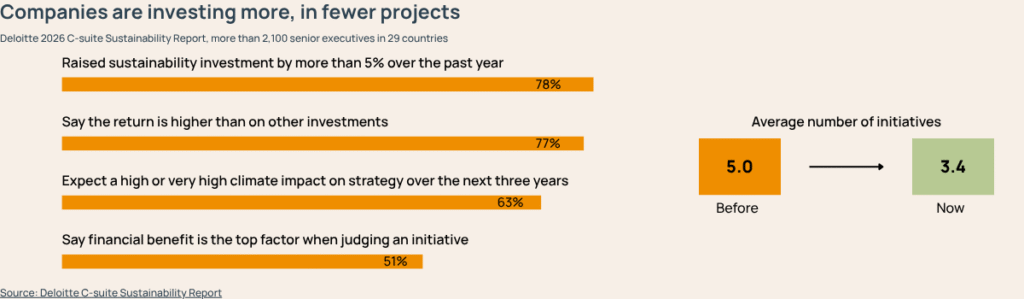
Deloitte’s 2026 C-suite Sustainability Report surveyed senior executives around the world. Most raised their sustainability investment over the past year, and most said the return is higher than on other investments.
Companies are also narrowing their focus. The average number of initiatives per company has fallen, about half say financial benefit is the top factor when judging an initiative, and a majority expect climate change to have a high or very high impact on their strategy over the next three years. All figures are shown above.
Source: [Deloitte C-suite Sustainability Report]
Most investors expect climate risk to move asset prices
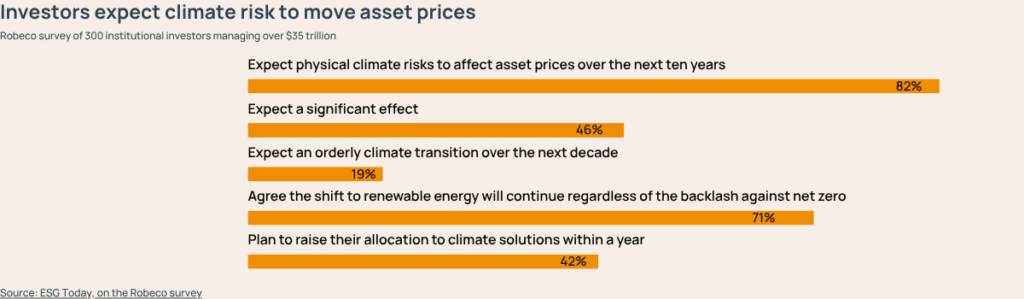
A Robeco survey of institutional investors found that most expect physical climate risks to affect asset prices over the next ten years, and nearly half expect a significant effect.
Few expect an orderly climate transition over the next decade. Yet most agree the shift to renewable energy will continue regardless of the backlash against net zero, and a large minority plan to raise their allocation to climate solutions within a year. All figures are shown above.
Source: [ESG Today, on the Robeco survey]
Stay a Step Ahead with TomorrowWorks
Sustainability regulation keeps changing, and the cost of guessing wrong keeps rising. TomorrowWorks helps organisations cut through the complexity of sustainability regulation: which rules apply to them, what they have to do, and by when. Find out how we can help [here].
**Know someone who should be reading this? Forward it on, and subscribe here: