

The revised ESRS are now law. Most of the other movement this fortnight was the EU turning proposals into binding text, while the US moved the other way.
Top story
The simplified ESRS are now law
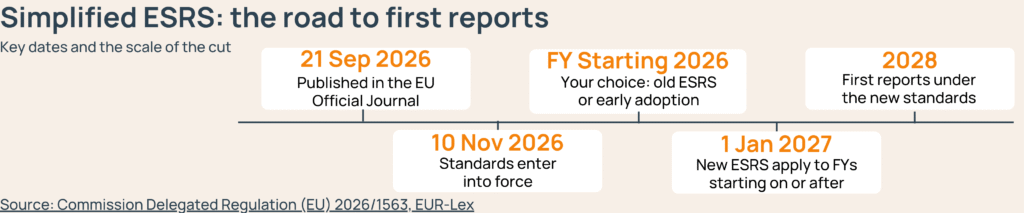
The revised European Sustainability Reporting Standards have been published in the EU Official Journal as Commission Delegated Regulation (EU) 2026/1563. The key dates are shown above.
They cut the number of mandatory data points sharply. The topics stay the same, but there are more exemptions and more room to leave things out.
The new standards apply to financial years starting from the date shown above, so the first reports under them follow in the year shown. Companies already reporting can choose: for a financial year starting in the earlier year shown, you may use either the old standards or move early to the new ones.
What to do: Decide now whether to early-adopt for that earlier financial year. If you do, rework your data collection before the year closes. If you do not, plan the switch into the following year’s cycle.
Source: Commission Delegated Regulation (EU) 2026/1563, EUR-Lex
EU proposes A-to-G sustainability ratings for data centres
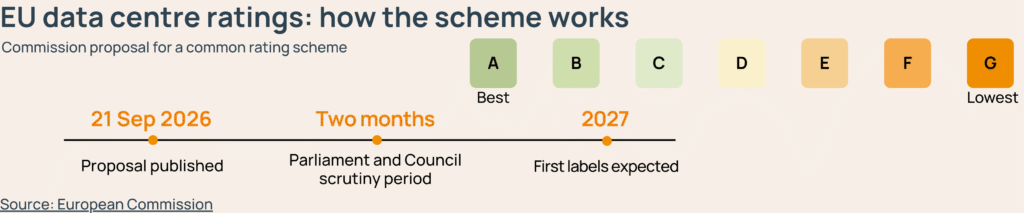
The European Commission has proposed a common EU rating scheme for data centres above the capacity threshold shown above. Ratings run on the scale shown and cover energy use, water use, clean energy sourcing and what the site gives back to the grid, such as reused waste heat.
Labels will be generated automatically from data centres’ own reported figures. The proposal now faces a scrutiny period in the Parliament and Council, and the first labels are expected on the timeline shown above.
The Commission also opened a call for evidence on minimum performance standards for data centres, which would set a floor rather than just publish a score.
What to do: If you operate or lease data centre capacity in the EU, start measuring power and water use efficiency now. Your rating will be built from figures you report.
Source: European Commission
Regulation & policy spotlight
Parliament votes to widen the carbon border tax to 457 more products
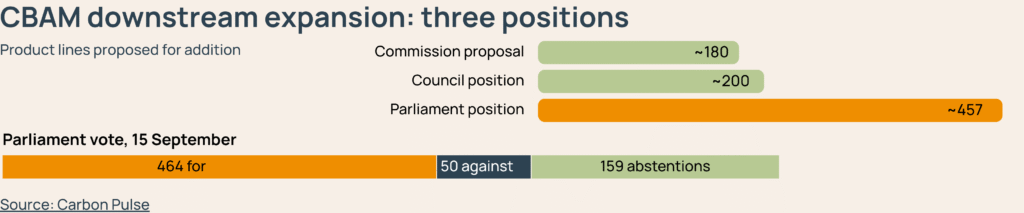
The European Parliament has adopted its negotiating position on extending the Carbon Border Adjustment Mechanism to downstream goods, by a wide margin (the vote is shown above).
Parliament wants far more product lines added than either the Commission proposed or the Council backed, as the comparison above shows. The list covers finished and semi-finished goods such as fasteners, wire, springs and household articles. MEPs also added stronger anti-circumvention rules.
This is not law yet. Parliament must now negotiate a final text with the Council, and the current CBAM product list stays in force until an amending regulation is passed.
What to do: Check whether your imported components appear on Parliament’s wider list, and ask suppliers now for embedded emissions data. Waiting for the trilogue outcome leaves too little time.
Source: Carbon Pulse
The deforestation product list is settled, and the December deadline holds
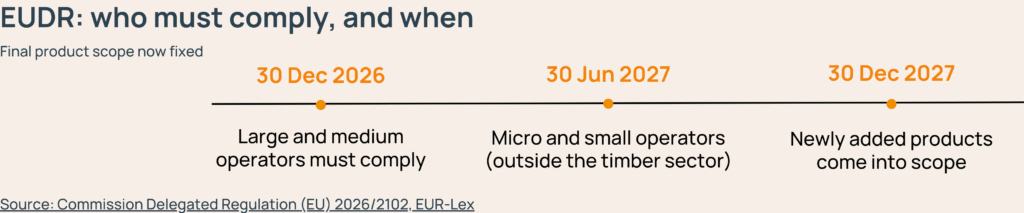
Commission Delegated Regulation (EU) 2026/2102 has fixed the final product scope of the EU Deforestation Regulation. It removes some items, including cattle hides and leather, re-treaded tyres and soybeans for sowing. It adds others, including soluble coffee, certain palm oil derivatives and frozen cattle tongues, which only come into scope from the latest date shown above.
The main application date has not moved again. Large and medium companies must comply from the date shown above for them. Micro and small operators outside the timber sector follow later, also shown above.
What to do: Re-check your product codes against the final Annex I. If you are a large or medium operator, your due diligence statements and geolocation data need to be ready before your deadline.
Source: Commission Delegated Regulation (EU) 2026/2102, EUR-Lex
Country & market spotlight
Germany sets 2045 as the date it stops using fossil fuels
On 23 September the German government published a roadmap for moving away from coal, oil and gas by 2045. Germany is the third country to publish one, after France and the Netherlands.
Renewables currently supply about 55% of gross electricity consumption. The government wants at least 80% by 2030. Coal leaves the power system no later than 2038, and new state-funded gas plants must be hydrogen-ready and run on climate-neutral fuels by 2045.
The plan also covers electrifying transport, heating and industry. The economy ministry framed it as an economic strategy as much as a climate one, pointing to the cost of imported energy.
Source: Climate Home News
Standards, reporting & frameworks
A voluntary standard for companies outside the CSRD is now law too
Published alongside the revised ESRS, Commission Delegated Regulation (EU) 2026/1560 sets out the Voluntary Sustainability Reporting Standard. It is for companies that fall outside the CSRD but are still asked for sustainability data by banks, investors and large customers.
This matters because the Omnibus narrowed CSRD scope sharply, to companies with more than 1,000 employees and over €450 million turnover. Most of the companies that dropped out of scope are still in someone else’s value chain.
What to do: If you are out of CSRD scope but fielding data requests, use the voluntary standard as your answer. It gives you one defensible format instead of a different spreadsheet for every customer.
Source: IAS Plus
Hong Kong consults on a wider green taxonomy, closing 7 October
On 7 September the Hong Kong Monetary Authority opened a consultation on the Phase 2B prototype of its sustainable finance taxonomy. It adds 10 activities across transport, manufacturing and waste management, taking the climate mitigation framework to 39 activities, up from 25.
It also adds 24 adaptation measures across water, energy, transport, buildings, ICT and risk management, and introduces a method for assessing adaptation activities. Battery manufacturing and recycling come into scope, and there are transition pathways for aviation and steelmaking.
The consultation closes on 7 October 2026.
What to do: If you raise or lend green finance in Asia, respond before 7 October. Taxonomy classification decides what can be labelled, and the adaptation methodology is new ground.
Source: The Standard
Legal watch
French court holds Yves Rocher liable for union crackdown at its Turkish factory
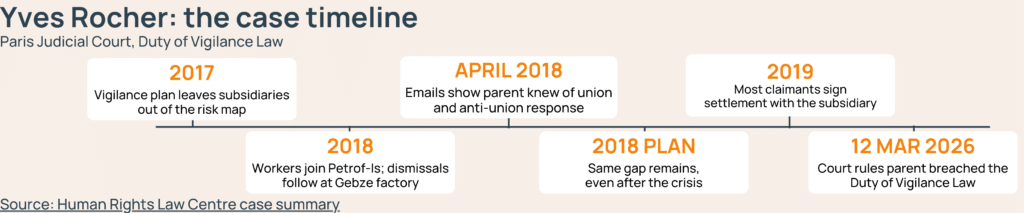
The 34th Chamber of the Paris Judicial Court has ruled that Laboratoires de Biologie Végétale Yves Rocher, the Yves Rocher Group parent, breached France’s Duty of Vigilance Law. The claim was brought by the NGOs Sherpa and ActionAid France, the Turkish union Petrol-Is, and a group of former employees of two Turkish subsidiaries.
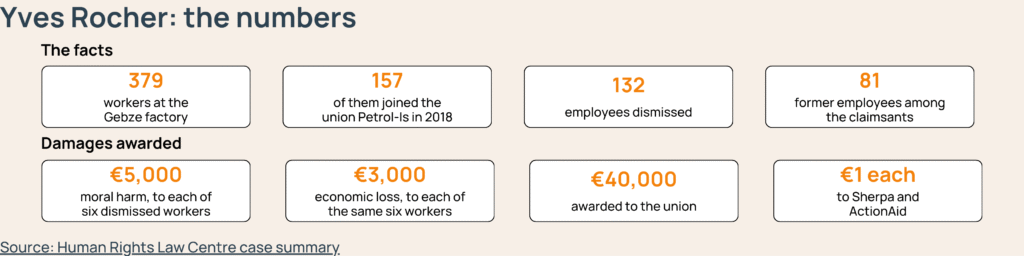
The facts: after a large share of the workers at a factory in Gebze joined Petrol-Is, many of them were dismissed (the numbers are shown above). Turkey’s labour inspectorate found the dismissals amounted to union oppression. The claimants argued the French parent had failed to identify and address that risk in its vigilance plan.
The court found the vigilance plans for the years shown in the timeline existed but were deficient. The risk mapping covered suppliers and subcontractors and left out the group’s own subsidiaries entirely, and that gap stayed in the later plan even after the crisis had happened. The court rejected the argument that local management had concealed events, noting emails showed the parent knew early on about the union and the anti-union response. A code of conduct and after-the-fact fixes did not cure the failure.
It is the first time a French company has been held liable under the law for harm abroad, and the court held the law is an overriding mandatory provision that applies regardless of Turkish law. Damages were modest, as the figures above show: small awards to individual dismissed workers and to the union, and a token amount for each NGO. Most claimants were shut out because they had signed an earlier settlement with the subsidiary.
The point for other companies is simple. Leaving your own subsidiaries out of a due diligence risk map can itself be the fault that creates parent company liability. The same logic runs through the EU Corporate Sustainability Due Diligence Directive, which the court cited.
Source: Human Rights Law Centre case summary – full judgment
Trends, research & insights
Consumer concern about sustainability rises for the first time in three years
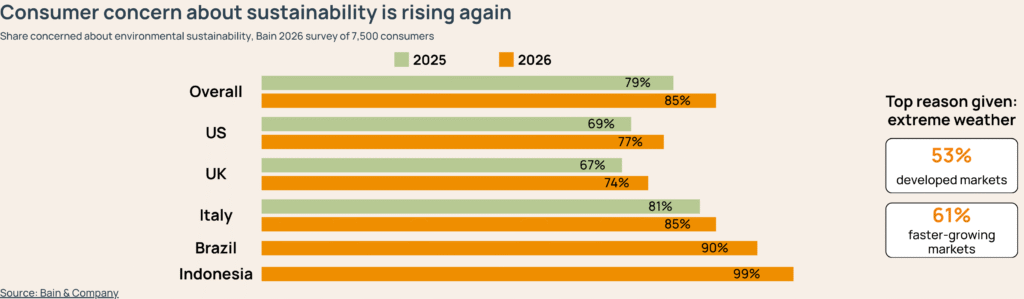
Bain & Company’s 2026 survey of consumers found concern about environmental sustainability has risen overall, the first increase after two years of decline.
The rise held across every market surveyed, including the US, the UK and Italy. Concern is higher still in faster-growing markets such as Brazil and Indonesia (all figures are shown above).
Extreme weather was the most common reason given, in both developed and faster-growing markets.
Source: Bain & Company
Stay a step ahead with TomorrowWorks
Sustainability rules are moving fast and rarely in a straight line. TomorrowWorks helps organisations cut through the complexity, turning shifting regulation, reporting standards and materiality into a clear, sector-specific strategy built for your goals and impact.